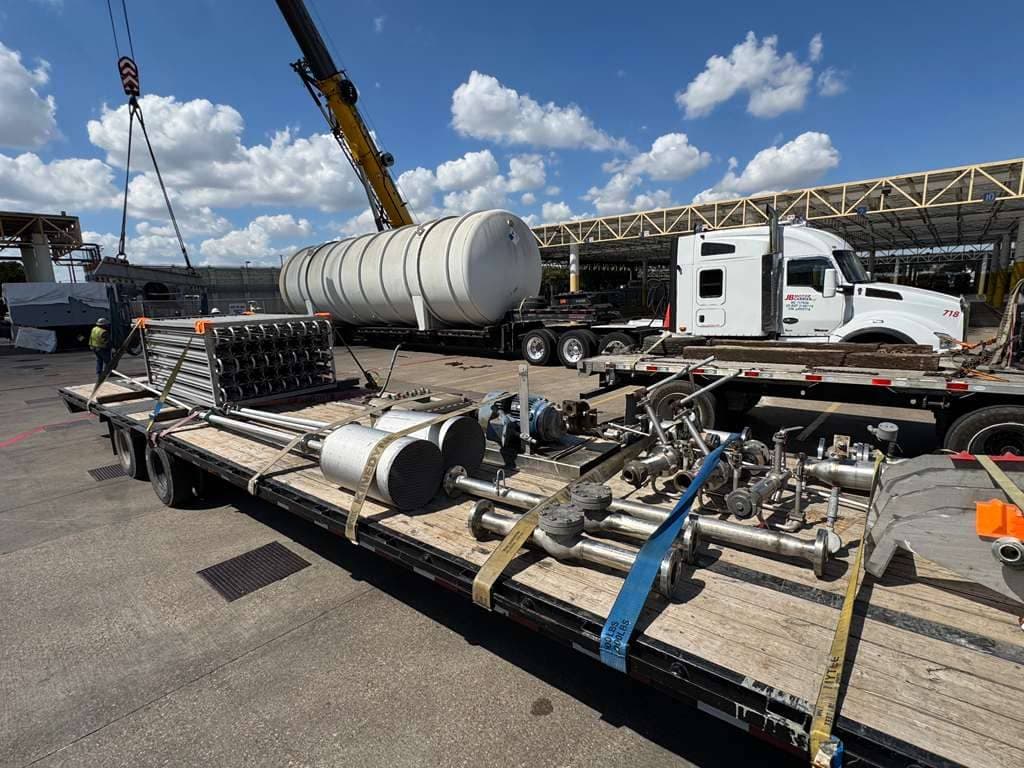
Oxygen Tank Removal
Operational Protocol
Removal
Process
Hydrocarbon-Free Validation
Before any mechanical dismantling begins, the entire system must be strictly validated as completely hydrocarbon-free. Even trace amounts of residual compressor oils or greases reacting with trapped oxygen during demolition can trigger a catastrophic explosion. This validation step is non-negotiable and precedes every other activity.
Cleaning for Oxygen Service
All surfaces, tanks, valves, and piping are cleaned per CGA G-4.1 (Cleaning Equipment for Oxygen Service) — the premier standard for any surface that will encounter oxygen concentrations above 23.5%. The methodology involves highly specific aqueous, semi-aqueous, and solvent cleaning validated against ASTM G93 to confirm complete removal of oxidizer-reactive contaminants.
Safe LOX Venting
Residual Liquid Oxygen is boiled off or transferred in heavily ventilated, outdoor exclusion zones. Venting near asphalt is strictly prohibited — LOX contact with asphalt, a porous hydrocarbon-rich material, can render it impact-sensitive and explosive. All venting areas are cleared of hydrocarbons, greases, and combustible ground surfaces before operations begin.
Atmospheric Control
Continuous oxygen enrichment monitors are active throughout the entire site. The atmosphere must remain below 23.5% O₂ — above this threshold, carbon steel, standard PPE, and even asphalt paving become highly flammable and can ignite explosively from minimal mechanical friction, impact, or static discharge.
Structural Dismantling
All cutting uses cold-cutting techniques exclusively — no sparks, no heat-affected zones. Anti-static gear is worn by all personnel. Every tool in the work zone must be hydrocarbon-free and verified clean for oxygen service before entry.
Transport & Logistics
Decommissioned LOX tanks are transported on properly placarded, vacuum-insulated multi-axle trailers per DOT/PHMSA regulations (49 CFR Parts 171–180). All pressure relief devices are verified functional before loading. For long-distance transport, holding time and vacuum integrity are evaluated to ensure PRDs will not activate on public roadways.
Regulatory Matrix
Safety &
Compliance
NFPA 55
Cryogenic Fluids Code
NFPA 55 dictates the overarching safety requirements, physiological hazard protection, and purging protocols for bulk oxygen storage systems — the foundational regulatory document for all LOX decommissioning operations.
OSHA 29 CFR 1910.253
Oil & Grease-Free Mandate
This OSHA standard explicitly mandates that all cylinders, valves, couplings, regulators, and apparatus be kept completely free from oily or greasy substances during all operations and handling. Violation can result in catastrophic ignition.
CGA G-4.1
Oxygen Service Cleaning Standard
The Compressed Gas Association's G-4.1 is the controlling standard for cleaning all equipment that contacts oxygen concentrations above 23.5%. Combined with ASTM G93 validation, it ensures every surface is verified hydrocarbon-free before exposure.
49 CFR 171–180
DOT/PHMSA Transport
Transport of decommissioned LOX tanks is strictly governed by DOT and PHMSA under the Hazardous Materials Regulations. Vacuum integrity and actual holding time must be evaluated before any tank moves onto public roadways.
Core Hazard — Oxygen-Enriched Atmosphere
If LOX leak or venting enriches the local atmosphere above 23.5% O₂, materials not normally combustible — including carbon steel, standard PPE, and asphalt — become highly flammable. They can ignite explosively from minimal mechanical friction, impact, or static discharge. All operations are designed around preventing this atmospheric threshold from being reached.
Our Capability
The Most
Demanding Standard
CGA G-4.1 Cleaning Protocols
We execute the full cleaning-for-oxygen-service protocol on every surface, valve, and fitting before any dismantling. ASTM G93 validation confirms contamination removal — we do not proceed without documentation.
Anti-Static & Hydrocarbon-Free Operations
All tools, equipment, and PPE used in the LOX work zone are verified clean for oxygen service. Anti-static grounding prevents static discharge ignition in enriched atmospheres.
HAZWOPER Certified LOX Crews
Personnel handling LOX decommissioning hold HAZWOPER certifications and have specific training for oxygen-enriched environment protocols under OSHA 29 CFR 1910.120.
Common Questions
FAQ
Oxygen-enriched atmospheres dramatically lower the ignition temperature and increase the burn rate of nearly all materials, including clothing, hair, and lubricants. Concentrations above 23.5 percent create conditions where materials that would not normally burn can ignite from a small spark or friction. Every tool, procedure, and material used in oxygen system work must be oxygen-clean and compatible.
CGA G-4.1 is the Compressed Gas Association standard for cleaning equipment intended for oxygen service. It specifies procedures for removing hydrocarbons, particulates, and other contaminants that could ignite in an oxygen-enriched environment. All tools and equipment that contact oxygen system components during decommissioning must meet this cleanliness standard.
Yes, with proper safety controls including oxygen monitoring at the work zone perimeter, hot-work exclusion zones, and fire-watch personnel. We establish clear boundaries between the decommissioning area and active operations. All adjacent activities involving open flames, welding, or grinding are coordinated through a unified hot-work permit system.
Hydrocarbons such as oil, grease, or thread sealant can auto-ignite on contact with high-pressure oxygen, causing fires or explosions with extreme intensity. This is why oxygen system decommissioning requires oxygen-clean tools, hydrocarbon-free lubricants, and rigorous contamination control. Our crews are trained to identify and eliminate hydrocarbon sources before any work begins.
Oxygen tanks must be transported in compliance with DOT 49 CFR hazmat regulations, even when empty, due to residual oxygen enrichment. We use specialized carriers with proper placarding, shipping papers, and emergency response information. All transport vehicles are inspected and drivers hold current DOT Hazmat endorsements.
More Capabilities