The Zero Incident Philosophy: Beyond Basic LOTO
The Zero Incident Philosophy: Beyond Basic LOTO
Lockout/Tagout is an OSHA requirement. It is not a safety program. It is the minimum legal floor beneath which serious injury or death becomes statistically predictable. At IGTR, LOTO is where the safety conversation begins — not where it ends.
Why LOTO Alone Is Insufficient for Industrial Gas Decommissioning
The 29 CFR 1910.147 standard for Control of Hazardous Energy was designed primarily for electrical and mechanical energy isolation in manufacturing environments. Industrial gas decommissioning presents energy types that LOTO was not designed to address in isolation: cryogenic stored energy, trapped gas pressure above MAWP, flammable vapor accumulation in confined spaces, and brittle fracture risk in pressure-cycle-fatigued vessels.
A textbook LOTO procedure on an LNG tank that verifies valve lockout but does not confirm annular vacuum integrity, residual product inventory, or atmospheric LEL at the work boundary is compliance theater. It satisfies the paperwork requirement while leaving real hazard pathways open.
Stop Work Authority as a Cultural Commitment
Stop Work Authority (SWA) is the right of every person on a IGTR jobsite — from the crane operator to the laborer on the tagline — to halt any operation they believe is unsafe, without fear of retaliation or criticism. This is not a policy statement. It is a behavior that requires constant reinforcement to survive contact with schedule pressure.
In practice, SWA is exercised about twice per project on average. Most stops are minor: an LEL monitor that needs re-calibration before the team advances, a missing blind flange identified during a pre-cut walkthrough. But the culture that normalizes these stops is the same culture that catches the catastrophic miss.
“Every stop costs money. Every fatality costs more. We've never had a SWA call we regretted.”
— IGTR Safety Director
Pre-Job HAZOP: Engineering the Work Before Touching It
Hazard and Operability Study (HAZOP) analysis, applied to field decommissioning, means systematically walking through every operational step — from the first valve opening to the final torch cut — and asking: what could go wrong here? What is the consequence? How do we detect it before it becomes an incident?
For a typical LNG tank removal, a IGTR HAZOP identifies 40–60 potential hazard nodes. Most are controlled by existing procedure. Roughly 10–15 require additional mitigation — a secondary monitor position, a different tool selection, a revised work sequence that changes proximity to an active process line. None of these would have been visible in a standard job hazard analysis (JHA).
Continuous Gas Monitoring: The Instrument That Doesn't Lie
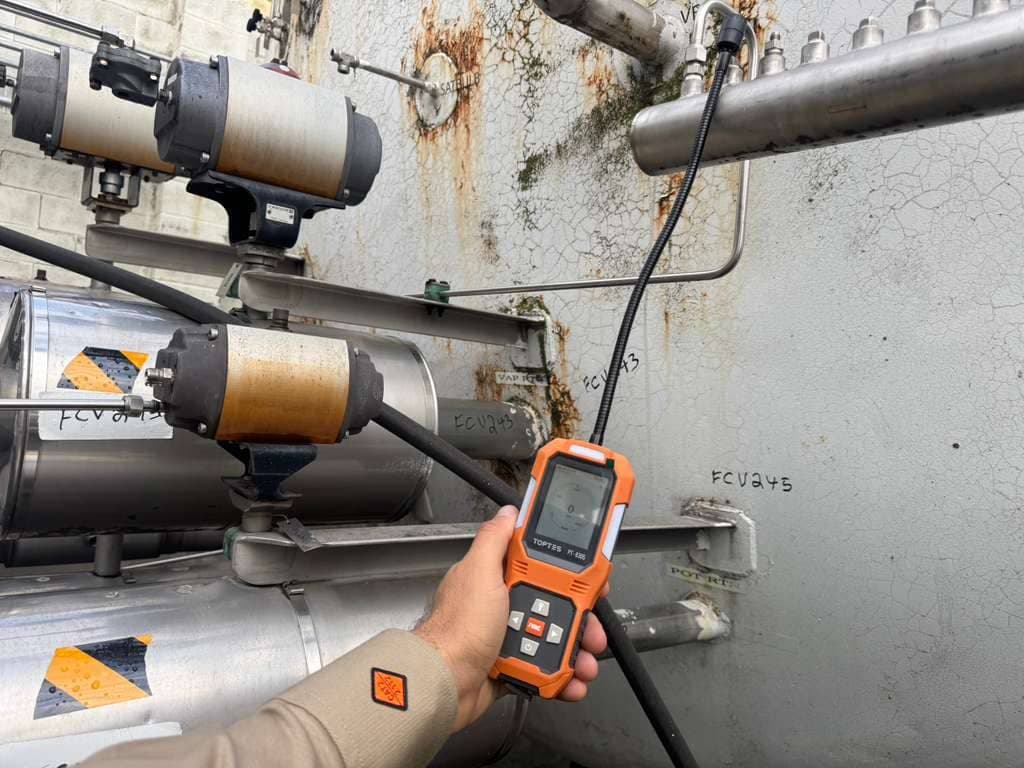
Every IGTR site operates with continuous real-time gas monitoring from the moment the crew arrives until the vessel is removed from the site. Fixed-point LEL sensors are positioned based on vapor dispersion modeling for the specific gas type and site layout. Personal gas monitors are worn by all personnel within 30 meters of the work boundary.
- LEL detection below 10% triggers a mandatory work stop and investigation
- LEL detection above 25% triggers immediate site evacuation
- H₂S detection above 1 ppm triggers mandatory respiratory protection escalation
- Oxygen deficiency below 19.5% activates confined space rescue protocol
The data from every monitoring session is logged and retained as part of the project safety record — available for regulatory review and as institutional learning for future similar scopes. Zero incidents is not luck. It is a system.
Article Details
Category
Safety Engineering
Published
February 05, 2026
Read Time
4 min read
Topic
Decommissioning
Field Operations
Zero-Spark Cutting Protocol
Discuss Your Project
Our compliance team is available to assess your facility and scope a fixed-price proposal.
Contact Our TeamRelated Pages
Next Step
Ready to
Discuss Your Project?
Our compliance team is standing by to assess your facility and deliver a fixed-scope proposal with asset recovery credits applied.