Case Study: 30,000 Gallon LNG Facility Purge
Case Study: 30,000 Gallon LNG Facility Purge
When a Gulf Coast LNG storage facility entered planned closure, the scope appeared routine: one 30,000-gallon cryogenic storage tank, scheduled for removal. The vessel's compromised annular vacuum changed everything.
Site Assessment and Scope Definition
The tank in question was a 30,000-gallon horizontal LNG storage vessel manufactured in 1987, with a design pressure of 120 PSIG and a maximum allowable working pressure (MAWP) of 110 PSIG. Preliminary assessment revealed the annular vacuum — the insulation layer between the inner and outer vessel walls — had degraded to approximately 500 microns. For reference, operational cryogenic tanks should maintain vacuum levels below 20 microns.
A degraded vacuum dramatically increases the rate of heat ingress into the inner vessel. This creates a compounding problem during purging: residual LNG product evaporates faster than in a properly insulated tank, generating internal pressure buildup that must be managed continuously. The standard purging timeline had to be abandoned.
The Challenge: Cascading Thermal Management
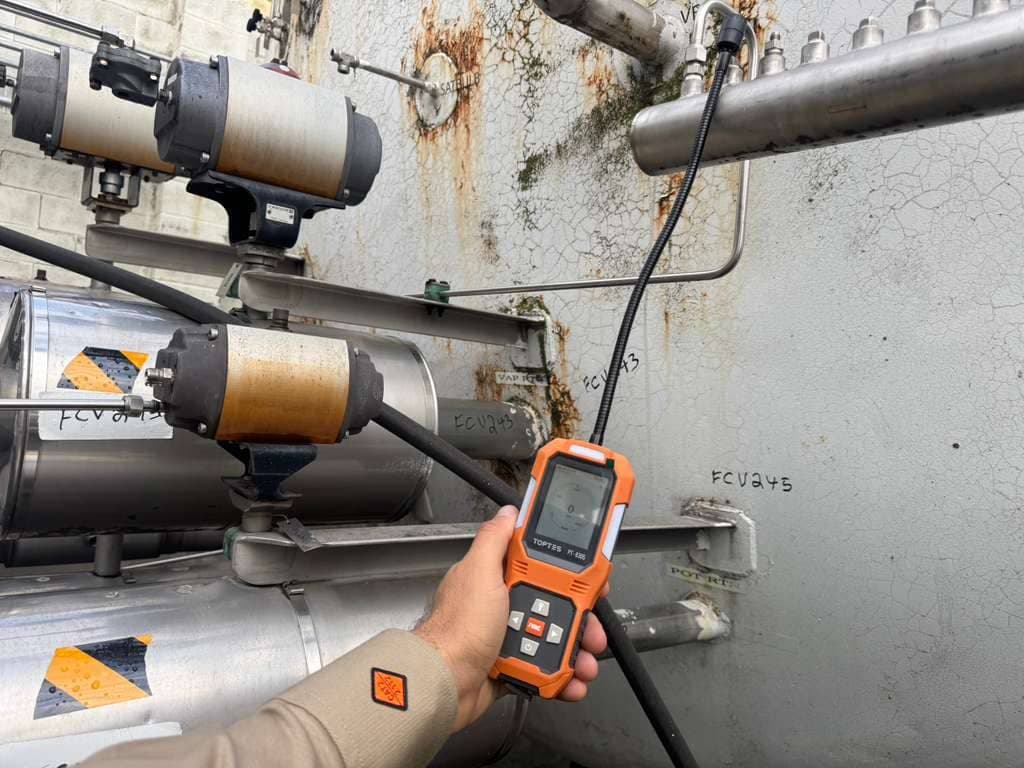
Standard nitrogen purging protocol for LNG vessels — introducing high-pressure nitrogen through the vapor return port to displace residual product — proved immediately insufficient. As nitrogen entered the vessel, the thermal differential was causing flash evaporation of LNG pooled in the lower vessel interior, generating methane vapor pockets that raised LEL readings above 40% within minutes of each purge cycle completion.
The challenge was to purge a thermally active vessel without creating conditions for vapor cloud accumulation, while working in a partially enclosed equipment bay with limited natural ventilation. A single-cycle approach would not achieve the 0% LEL threshold required before any mechanical disconnection.
Solution: Heated Nitrogen Cascade Purging
Our engineering team implemented a two-stage heated nitrogen cascade purging approach developed specifically for compromised cryogenic vessel decommissioning. Rather than introducing nitrogen at ambient temperature — which creates thermal shock and accelerates flash evaporation — the nitrogen carrier gas was pre-heated to approximately -50°C using inline electrical resistance heaters. Cold enough to prevent thermal shock to the inner vessel; warm enough to avoid re-condensation of methane vapor.
The cascade sequence introduced nitrogen at one-third vessel volume, held for a 15-minute stabilization period with continuous LEL monitoring at three interior measurement points, then vented to atmosphere through a 100-foot stainless flex hose to a safe dispersal zone upwind of the facility. Eight complete cycles over 14 hours.
“The cascade approach is slower and more expensive than a single-cycle purge. On a compromised vacuum vessel, it's the only protocol that guarantees 0% LEL before any cutting tool touches the vessel.”
— Field Operations Lead, IGTR
Result
After the eighth purge cycle, all three interior monitoring points confirmed 0% LEL. The vessel was held at positive nitrogen pressure for a final 2-hour hold verification before the purge rig was disconnected. Mechanical disconnection and 100-ton crawler crane extraction proceeded without incident.
- Total purge duration: 14 hours across 2 operational shifts
- Nitrogen consumed: approximately 4,200 cubic feet
- Maximum LEL recorded during operations: 62% (initial de-pressurization phase)
- Final LEL reading prior to mechanical disconnection: 0.0%
- Regulatory outcome: GHGRP documentation submitted; no citations issued
Article Details
Category
Case Study
Published
February 20, 2026
Read Time
8 min read
Topic
Decommissioning
Field Operations
Zero-Spark Cutting Protocol
Discuss Your Project
Our compliance team is available to assess your facility and scope a fixed-price proposal.
Contact Our TeamRelated Pages
Next Step
Ready to
Discuss Your Project?
Our compliance team is standing by to assess your facility and deliver a fixed-scope proposal with asset recovery credits applied.